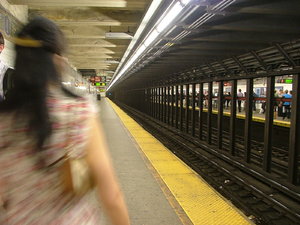
As our Boston Personal Injury Lawyers recently reported, ridership on the T has increased in recent months.

Massachusetts Bay Transportation Authority (MBTA) officials are crediting the new See Say smartphone app for the increase.

It’s helping riders to navigate their trips a whole lot easier, allowing them to see exactly where their ride is and when it’s supposed to arrive. It’s also helping to give riders a piece of mind. The app also allows residents to report any kind of suspicious activity that they see on the MBTA to Transit Police. With just a click of a button, MBTA riders can upload accident reports and they can share both text and pictures. All of these features are helping riders to stay safe during transit and to help them to get to and from their destinations in a timely manner.
muO79BA.jpg
“Transit Police are always looking for new tools to empower riders,” said Paul MacMillan, MBTA Transit Police Chief.

Our Boston personal injury attorneys understand that communication is an important part of traveling throughout the city. When riders are joining in, we have eyes and ears throughout the MBTA system. With participation from riders, we can help to hold the MBTA accountable for a comfortable and safe transit environment. It starts with you. With everyone involved we can have the safest transit system in the country.

In addition to the app is the “If You See Something, Say Something” campaign and it is using efforts from both local and state agencies to help to educate the riding public. The campaign is helping riders to keep an eye on their surroundings at all times when using public transportation. Riders are urged to report anything that they feel is suspicious. You can make these reports with the click of a button through the new app.

This campaign was first launched back in 2003 by the MBTA after it learned of a similar campaign from New York City’s Metropolitan Transit Authority. It’s currently being funded through a grant from the Department of Homeland Security’s Transit Security.

What’s exciting is that Massachusetts and the MBTA are the first in the country to release a smartphone app as a part of the “If you see something, say something” campaign.

The See Say app:

-has been created for transit and other areas that don’t have very good cell phone reception. With the app, reports will be sent as soon as the rider has a signal.

-is discrete. It allows riders to send out reports anonymously. The app shuts off a rider’s camera flash on their phone when taking a picture of something suspicious.

-sends reports directly to the Transit Police dispatch center.

-lets riders know about delays and service issues through T-Alerts.

Officials with the MBTA say that it’s important that we all look out for one another. Report all suspicious activity to help keep all of our fellow riders safe.
Continue reading

Throughout the month of April, ridership totalled nearly 1.5 million per weekday. That’s the third month in a row in which the ridership has been more than 1.3 million and the 15th month in a row in which we saw increased ridership, according to the Boston Globe.

As the number of riders continues to increase, so do the risks for MBTA accidents in Boston and the surrounding areas. Although many residents use the MBTA ride each and every day, sometimes riders can become complacent and forget to practice safe traveling habits.
mqKAycg.jpg
From April of 2011 to April of 2012, we saw a near 5 percent increase in ridership across the entire Massachusetts Bay Transportation Authority (MBTA) system. During this time, weekday bus ridership reached more than 400,000 as well. This is the first time we’ve ever see bus ridership go beyond 400,000 for two consecutive months.

Our MBTA accident lawyers understand that one of the main reasons for the increase in ridership may be because of the availability of real-time MBTA arrival information for MBTA buses. Through this technology, riders can access apps and websites regarding the T and where their rides are in the palm of their hand, through their smartphones. These new apps were built by independent developers and help to alert riders about the location of their bus or train and when exactly it will arrive. These apps help to alleviate a lot of the confusion and the rush throughout our MBTA system. Informed travelers are prepared travelers.

“With help from a lot of innovative developers, we continue to build on the previous achievements of our trail-blazing open data initiative,” said MBTA General Manager Richard Davey.

With all these riders, it’s no secret that the T is a popular way for both residents and visitors to get around town. Again, we’re asking riders to be cautious when riding the MBTA’s buses, trains and subways. While they’re awfully convenient, they can be awfully dangerous, if you’re not careful that is.

“More than a hundred thousand smart phone users have downloaded apps that provide arrival time information for more than 180 MBTA bus routes,” said Jonathan Davis, MBTA General Manager.

Increase in Ridership:

-More than an 8 percent increase on the Green Line.

-Nearly 4 percent on the Blue, Orange and Red Lines.

-Ridership on commuter boats was up nearly 12 percent.

During the month of April, officials with the MBTA also voted 4-1 to raise most of our subway fares by about 30 cents. Bus fares were voted to be raised by 25 cents as well as a hike in commuter rails by about $1.25 starting in July. This is the first fare increase by the T in the last 5 years.
Continue reading

You could call employees with the Massachusetts Bay Transportation Authority (MBTA) lifesavers. Well, maybe more like bunny savers.

According to CBS Boston, workers stepped in just in time to save a little girl’s best friend who had accidentally fallen onto the tracks. It all happened when Casey and Michelle Carey-Brown’s 3-year-old said that her little bunny friend was nervous about their family trip on the T. The family and their bunny friend were heading from Stony Brook to Green Street on the Orange Line when the accident happened. As they exited the train, their furry friend fell out of the little girl’s stroller and onto the tracks below. There it sat, in between the train and the loading platform, serving as a sitting duck for a potentially fatal bunny accident in Boston.
nxwTRxm.jpg
The little girl, without hesitation, screamed and reached out for her friend. Her parents scurried to find an MBTA employee for assistance in saving their furry family member. They located a T worker who was able to call ahead to the conductor of the train. The cars were stopped during the middle of rush hour so that the conductor could get out, grab the bunny and toss it back to the little girl, safe in her arms.

Our Boston personal injury lawyers understand that it can be difficult to travel with children. When riding the T, there are a lot of passengers to keep an eye on, fast-moving trains and dangerous tracks below. It’s important to travel with a plan and to keep safety as a number one priority, especially for your children. To help you to better travel with your young ones, we’re here to offer you some subway safety tips for children.

Subway Safety:

-Travel slowly. Most accidents in the subway result from slips, trips and falls on boarding docks and on stairs. Be sure that children never play on a boarding platform. It’s a lot easier than you think to fall from the platform and onto the tracks.

-This is not a time to live life on the edge. When waiting for the subway to arrive, make sure that you and your family are waiting behind the warning strips and away from the edge.

-Be careful with strollers. These items should never be used on the stairs. Make sure that you fold them up and carry infants before walking up or down stairs. When you have a stroller on the boarding platform keep the stroller away from the edge and keep your hand on the brake.

Parents are asked to keep an eye on their young travelers. You know how busy our subway systems can get. Keep an eye on your little ones and make sure to keep your family together and safe. Responsible traveling habits help prevent potentially fatal accidents.
Continue reading

Dangerous products find their way into the homes of many residents in the state of Massachusetts. Unfortunately, not many consumers are alerted to the dangers of these products and their recalls. Oftentimes, these recalls never even get to consumers until a fatal accident in Boston or elsewhere has already occurred, according to TIME.
meZbBva.jpg
Statistics show that about 90 percent of dangerous products stay in consumers’ homes. After being recalled, there are very few products are ever returned by consumers to the manufacturer for a refund or for the necessary repairs.

Our Boston defective product attorneys understand that our day to day lives are busy. We’ve got a lot to do and a seemingly little amount of time to do it. Still, there’s no excuse to bypass safety, there’s no excuse not to be up to date with the latest recalls and there’s no excuse to hang on to a dangerous product. Residents are encouraged to check out the recalls from the U.S. Consumer Product Safety Commission frequently. If you notice that you have a product that’s been thrown on the recall list, you’re strongly urged to get rid of it, to return it for a refund or take it back to the manufacturer for a repair. Keeping these items in your household and around your children is a quick recipe for disaster.

“We know that the majority of products that are recalled remain in consumers’ homes,” said the executive director Kids in Danger, Nancy Cowles.

Remember the furnaces that the CPSC recalled? There were about 200,000 recalled be federal officials. Still, more than 90 percent of the accident reports that were submitted were submitted after the recall. Consumers still decided to hang on to these furnaces long after they were deemed unsafe.

But why do consumers hang on to dangerous products?

-Because they feel that they won’t be affected by the risks or the dangers of the product. It’s the “bad things happen to other people, not me” complex.

-Because recalls happen all too often and they’ve lost their sense of urgency and the importance that they once had.

-Because consumers never hear about the recalls in the first place. Safety officials believe that there needs to be a more efficient way to spread the word.

You’ve got to be an active and engaged consumer and you need to stay up to date with the latest safety recalls if you’re going to help to protect your loved ones. It’s important to know what dangers lie in products before going shopping and long after. Knowledge is your key in this battle and it can help to prevent serious injuries to both you and your family members.
Continue reading

Recent statistics from the Governors Highway Safety Association (GHSA) note that fatalities from auto accidents nationwide are declining. Well, all of them except motorcyclist fatalities.

According to statistics from the first 9 months of 2011, the number of motorcyclist fatalities has remained the same compared to the previous year, both sitting at nearly 5,000, according to webBikeWorld.
54505_motorcycle_01.jpg
The U.S. is seeing some of its lowest fatality rates since 1949. But the number of fatal motorcycle accidents in Boston and elsewhere just don’t seem to budge despite all of the nationwide efforts to raise awareness about these vulnerable drivers. There have been a multitude of campaigns and safety events dedicated to getting drivers to be more aware of our two-wheeled friends on the road but nothing seems to work.

This is worrying officials because while we may have just rounded out National Motorcycle Safety Awareness Month, we’re heading into the summer travel season which allows for more bikers to hit our roadways. With more bikers on our roadways, we see higher risks for accidents and ultimately more fatal accidents than any other time of the year.

Our Boston motorcycle accident attorneys understand that we’re seeing a lot more motorcyclists on our roadways. It’s the summer, it’s that time of year when the weather clears up, the sun shines through and our two-wheeled friends hit the road. It’s also a time to raise awareness. For that reason, we’re asking motorists to be on the lookout and to help reduce the risk of accidents.

Experts believe these accidents have remained steady because:

-The improving economy has allowed residents with more spending money to purchase motorcycles.

-The high gas prices has more residents riding motorcycles to save at the pump.

-Motorcycle helmet laws are lacking in many states. When motorcycle helmets are not mandatory, less motorcyclists wear them. The fewer helmets on our roadways the more fatal accidents we see.

Dr. James Hedlund of Highway Safety North has done much research into gas prices and the status of the economy with the number of motorcyclist fatalities and there seems to be a direct correlation between them. When the economy is doing well, the number of motorcycle registrations is typically up and so is the number of accidents. When gas prices are high, the number of motorcycle registrations typically rises as well as the fatality numbers. These patterns have been pretty steady since 1990, allowing experts to pretty much predict when we’re going to see more fatal motorcycle accidents on our roadways.

“It is disappointing that we are not making progress in motorcycle safety, particularly as fatalities involving other motorists continue to decline,” said GHSA Chairman,
Troy Costales.
Continue reading

A recent fall accident in Chelsea sent a 2-year-old out of a third-floor window and down about 50 feet to the ground below. According to the Boston Globe, the young girl is expected to make it. Officers believe that the girl was playing with some of her friends on a bed in the home that was located next to a window. They believe that the window was left open and the young girl fell out and into the alley below. Officials have not determined if the child was supervised or not at the time of the accident.
mqK6q28.jpg
Just a week ago, a 2-year-old girl died after she fell from a third-floor window in Fall River.

Our Chelsea injury attorneys understand that there are nearly 2.5 million children under the age of 14-years-old who are treated in emergency rooms across the country because of fall-related accidents.

According to recent statistics, there fall-related accidents kill about 80 of these young ones every year. More than half of the injuries occur to children under the age of six. Window falls are some of the most serious of these kinds of accidents, especially for our young ones. Every year, nearly 20 kids under the age of 11 die from window falls. Another 4,700 kinds under the age of 14 require treatment each year because of these same accidents. Children don’t understand the dangers that are associated with heights. They’re also not able to calculate the dangers of playing near windows. Many don’t understand that there are risks of a dangerous fall. For this reason, it’s parents’ responsibility to keep a close eye on their young ones near windows and to make sure that all windows are properly guarded.

Luckily, there are ways to help to keep our children safe near windows.

According to the Boston Public Health Commission, parents, guardians and property owners are urged to safeguard all windows to make sure that children don’t have access to them and that they can’t get out of them! That’s why the state participates in the Kids Can’t Fly campaign, to help to educate communities about window falls, prevention and the use of child safety window guards.

Tips to Protect Children from Windows:

-Be sure to install window guards on all windows that are above the first floor.

-If you have to open a window for ventilation, be sure that your child can’t reach the open window.

-Make sure you have ground rules in your home and that children know not to play near windows.

-Move your furniture away from all of your windows.

-Never rely on window/insect screens to keep children from falling out of a window. They’re not strong enough and will not keep your child in.
Continue reading

To help to stop teen car accidents in Quincy and elsewhere, AT&T recently launched its “It Can Wait” campaign.

The campaign started in the state of Massachusetts back in 2011 and since then organizations and law enforcement agencies across the country have joined in to help to raise awareness about the risks of distracted driving among teen drivers nationwide, according to The New York Times. This campaign usually takes place during the summer months because it’s during this time that teen drivers face the most dangerous risks for car accidents.
domesticviolencephone.jpg
“Memorial Day is the beginning of the 100 deadliest days of the year for teen drivers,” said president of AT&T in the New England area, Patricia Jacobs.

Our Quincy car accident lawyers understand that teens know that texting while driving is dangerous. Studies prove it! Unfortunately, studies also show that these young drivers are still sending and receiving text messages behind the wheel. According to a recent AT&T study, more than 95 percent of teens know that it’s dangerous to text and drive at the same time. The same study also revealed that nearly 45 percent of these young drivers are still texting behind the wheel and another 75 percent say that their friends are doing it on a regular basis.

The study revealed that teens feel peer pressure from their buddies to respond to these messages quickly and that’s why they’re not waiting. The study also illustrated that parents and other adults are setting a poor example behind the wheel, leading these young drivers to believe that it’s okay to text and drive.

It’s going to be tough to get these young drivers to put the phones away while they’re on our roadways. Text messages rank as the number one mode of communication among this young age group. Recent studies conclude that teens text about five times more than most adults in a day. When this is going on behind the wheel, teens are nearly 25 times more likely to be in a near-accident or an actual accident on our roadways.

Highlights of the AT&T study:

-Nearly 90 percent of teens say that they expect to get a reply to a text message or an email within 5 minutes of sending the message.

-Three quarters of teens know that texting while driving is dangerous, yet nearly 45 percent still do it!

-About 70 percent of teens say that it’s still dangerous to text while stopped at a stop light.

-About 60 percent of teen say that they will text at a red light and another 75 percent say that they’ll at least peek at their phone at a red light.

-More than 60 percent of teens admit to glancing at their phone while driving. The same number of teens say that they’ll read or send an email or text while driving.

-Nearly 80 percent of teens say that adults tell them not to text and drive but these same adults text while driving.

-More than 40 percent of teens say they see their own parents send or read texts and emails while driving.
Continue reading

In 2011, the state of Massachusetts was ranked the 9th safest bicycling state in the Northeast. In 2010, we ranked in at 16th place and in 2009 at 19th place, according to a study conducted by the League of American Bicyclists.

In 2012 we are ranked in 3rd place! We’re getting better and our roadways are getting safer for bicyclists, but we still have a long way to go. For the fifth straight year in a row, Washington ranked in at number one. Unfortunately, even with a 3rd place ranking bicycling accidents in Boston and elsewhere are still a common occurrence.
mLcJUUu.jpg
“We are encouraged to see significant progress in top states like Washington, Minnesota, Colorado [which ranked fourth this year] and Massachusetts,” said Andy Clarke, president of the League.

Our Boston bicycle accident lawyers understand that this recent study illustrates there is still much to be done to make our roadways safer. Thousands are still being injured on our roadways every year. Many of these changes need to be done in funding and in infrastructure. Overall, the study concluded that state DOTs and legislatures across the country are lagging behind when it comes to bicycle safety even though there’s a much higher demand for safe riding areas.

In the study, the League of American Bicyclists looked at each state’s enforcement and legislation, programs and policies, funding and infrastructure, encouragement and education and their planning and evaluation. States were then ranked on these categories and their contributions to bicycling traffic.

Richard A Davey, the Secretary for the Massachusetts Department of Transportation (MassDOT), said the department marks its commitment to provide residents and visitors with efficient, healthy and safe forms of transportation and continues to push the importance of the GreenDOT policy.

In April, the League of American Bicyclists named MassDOT and another 66 organizations as being Bicycle Friendly Businesses. Our state was the first state to have its DOT to receive national recognition for this kind of thing, according to the Boston Globe.

Recently, MassDOT launched the GreenDOT program to help to push environmental responsibility and a sustainability initiative to help make our state a national leader in “greening” the state transportation system. With pushing bicycling in the city, officials have also had to make some changes along our roadways to protect these travelers.

Awareness of bicyclists has also been important with the re-launch of the Hubway system, which allows residents and visitors to rent a bike, ride to their destination or where ever else and just return it to another kiosk in the area.

Other rankings in the New England area:

-Vermont: 18.

-Connecticut: 20.

-New Hampshire: 27.

-Rhode Island: 27.

We may be ranked higher than many of our neighboring states, but it’s no time to rest. We need to continue pushing forward to making biking in Massachusetts the safest it can be!
Continue reading

According to a recent study from the Robert Wood Johnson Foundation and groups with the Trust for America’s Health, the state of Massachusetts ranked third in the nation for injury prevention measures. Our state had some of the lowest fatality rates, sitting at about 41 deaths per 100,000 residents resulting from fatal auto accidents in Boston and elsewhere every year. The national fatal injury rate sat at nearly 60 per 100,000 residents.
1370965_slick_chrome_number_buttons_3.jpg
Included in this report were a number of injury prevention policies that states could enact to help to reduce the number of fatal accidents, according to the Boston Globe. Some of these prevention strategies include strict drunk driving laws, seat belt laws and other regulations to help to prevent domestic violence. Our state was proud to check off 7 out of the 10 recommended policies. Only New York and California ranked higher than us, both being able to check off 9 out of the 10 recommended policies.

Our Boston personal injury attorneys understand that our state has a good number of laws in place that help to reduce the risk of injury. It’s up to residents and visitors to abide by these laws for them to actually work. Some of the laws that our state already has include requiring bicyclists under the age of 16 -years-old to wear a helmet, requiring all motorcyclists to wear a helmet on our roadways and requiring all child passengers under the age of 8 to be placed in the proper child seat.

We did lose some points though. We got some marked off for still having our seat belt laws as secondary enforcement. Officers are not allowed to pull over a driver just because they don’t have their seat belt on. They have to be breaking another road law before they can be pulled over and cited for not wearing a seat belt.

Massachusetts was however, praised for our laws and regulations to help to prevent and to manage concussions, to keep an eye on prescription drugs and to help to prevent accident overdoses and to make it relatively simple to file and complete a restraining order against a partner who has been deemed violent. Still though, many officials say that there’s a whole lot more that could be done and we need to continue working our way to the number one spot as the safest state in the country.

During the summer season, students are out on summer break, families and residents are venturing out on summer vacations and millions of tourists are heading to the area. Make sure that, no matter what you do, you keep safety as a number one priority.
Continue reading

Contact Information