Sometimes a loved one or family member reaches a point where they can no longer receive sufficient care at home. While it is often a difficult decision, arranging for a loved one to enter into a managed care facility or nursing home is often most loving choice we can make. We trust the facility and staffers will better care of our family member than we could at home.

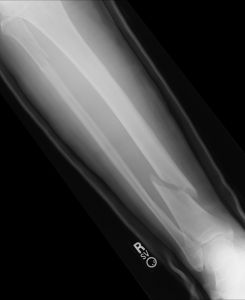
broken-leg-xrayseries-1-978477-m.jpgIn Mattox v. Life Care Centers of America, an elderly woman was receiving care from a nursing home owned by defendant. She was 86-years-old. During her stay, she suffered a fall and fractured her femur. She was taken to the emergency room, where doctors gave her pain medication. She then suffered nausea, vomiting and aspiration. She was not stable enough to have surgery to repair her broken leg, was placed in “comfort care,” and died just after midnight.

Plaintiff’s son filed a wrongful death lawsuit against defendant, alleging they were aware she had a history of falling and did not take proper care to prevent her from falling and breaking her leg. Defendant filed for summary judgment on grounds plaintiff failed to name an expert who would testify that defendant didn’t adhere to the required standard of care with respect to plaintiff’s death, and further had not introduced any evidence to prove the fall was the proximate cause of plaintiff’s death.
Continue reading

When we send our children to school, we assume that school officials will take proper precautions to make sure our kids are safe. In Lyons v. Richmond Cmty. Sch. Corp, a case from the Indiana Supreme Court, plaintiff was the parent of a 17-year-old high school student with Down syndrome who was considered severely disabled. She had trouble eating and failed to chew her food or frequently took too many bites before attempting to swallow.

1334532_ambulance.jpgA contractor hired by the state worked with her school to develop a safety plan for the girl, which included a requirement that staff monitor her closely at every meal or snack. She was never to be left alone while eating. Specifically, the plan said the girl tended to shove food into her mouth and will choke if not carefully supervised. She required constant monitoring and verbal prompts to slow down. Additionally, the school had an established procedure that required staff to cut up all the girl’s food.
Continue reading

Slip-and-accidents can result in serious personal injury to plaintiffs. Zuppardi v. Wal-Mart Stores, Inc., an appeal heard by the United States Court of Appeals for the Seventh Circuit, involved a plaintiff who went to a big box retail store (“defendant”) along with her brother and son.

caution-wet-floor-sign-1-1006453-m.jpgPlaintiff took a shopping cart from the front of store and pushed it down a highly-trafficked walkway known in the industry as an “action alley.” Plaintiff was walking at normal speed and did not see any other customers around her when she slipped and fell in a puddle of what she believes to be water. She landed on a concrete floor. She believed the puddle of liquid was water, because it was colorless odorless.

Plaintiff testified it was about two feet across and blended in with the floor very well. According to court records, there were no warning cones or danger signs or footprints or shopping cart tracks around the puddle, and she did not know how it got there.
Continue reading

Entergy Mississippi, Inc. v. Acey, a case from the Supreme Court of Mississippi, involved a child who was electrocuted while playing on a farm.

power-1418237-m.jpgEmployee was operating a cotton picker and parked it under an allegedly sagging power line. The child climbed onto the parked cotton picker, touched the power line and was electrocuted.

During his deposition, employee testified that he and his sons were unaware that farm owners’ daughter and her friend, the electrocuted child, were playing nearby. One of employee’s sons saw a flash, and they immediately ran to the area where the flash originated and found plaintiff on top of the cotton picker. Employee held the child until paramedics arrived.
Continue reading

Kovnat v. Xanterra Parks and Resorts, a case from United States Court of Appeals for the Tenth Circuit, involved plaintiff who was injured while horseback ridding in Yellowstone National Park.

western-saddle-941483-m.jpgPlaintiff and her husband, both from California, traveled to the park in Wyoming for a vacation. While on vacation, they went on an evening horseback ride. Defendant is the provider of the horseback riding attraction.

Plaintiff, her husband, and other tourists were asked to sit on a bench while they were instructed on how to ride a horse. Defendant alleges that all riders are told that if they feel the saddle slip, even slightly, they should stand up in the saddle and attempt to straighten the saddle. They are also told to tell a wrangler that there is a problem with the saddle.
Continue reading

Powers v. 31 E 31 LLC, a case from the New York Court of Appeals, involved plaintiff who was injured at a friend’s apartment building. After a night of drinking, plaintiff and some friends went to apartment where the accident occurred.

rusty-roof-1445317-m.jpgWhile at the apartment, the group stepped through a window to access the roof deck. The window opening was nearly a foot and a half wide and a little more than two feet high. The roof area flat enough to walk on was five feet wide and extended the entire length of the building. The portion of the roof abutted the exterior wall of the next building.

At one portion of this flat roof, an airshaft separated the two buildings. The airshaft consisted of a 25-foot vertical drop with no railing or other protection to keep people from falling into the shaft. The opening of the shaft was approximately four feet by eight feet.
Continue reading

In order to stay competitive, farmers are constantly relying on complex machinery to get the job done. In Yanmar America Corporation v. Randy Nichols, a farmer purchased a new tractor that contained both a front loader and a brush hog attachment. This particular tractor did not feature a rollover protection structure (ROPS) in the design.

plowing-1328815-m.jpgPlaintiff and his brother were using the tractor to “brush hog” a parcel of land that featured a significant slope. Plaintiff did not inspect the hill on foot prior to taking the tractor up the hill. According to court records, plaintiff was driving the tractor in tall grass at walking speed when he turned around to check on the brush hog attachment.

When plaintiff turned back around, he felt the front tire drop as if it was falling into a hole in the ground. It was actually a ledge or drop off on the edge of the hill that caused the tractor to roll over sideways. After rolling a complete 360 degrees, the tractor was back on its wheels, but plaintiff was thrown from the tractor during the roll.
Continue reading

When we send our children to the doctor, we assume doctors and healthcare providers have been screened for any issues in their backgrounds. A recent case from the Massachusetts Supreme Judicial Court (SJC), Roe No. 1 v. Children’s Hosp. Med. Ctr., centers on this issue.

hospital-corridor-2-65904-m.jpgIn Roe No.1 (Roe being used in place of the name for plaintiff who is a minor), a doctor was hired by a Boston pediatric hospital in 1966 to work as a pediatrician. The doctor held the position until leaving the hospital in 1985 to work as a pediatrician at an out-of-state hospital.

After 24 more years of working as a pediatrician, he voluntarily surrendered his license to practice medicine in the face of allegations that he performed a number of unnecessary genital examinations on his patients.
Continue reading

Crocker v. Morales-Santana, a case from the North Dakota Supreme Court, involved a sheriff who suffered serious personal injury when his patrol car was hit by a semi-tractor trailer driven by defendant.

truck-1192523-m.jpgThe police car was parked on the north side of an interstate, while the sheriff was helping a stranded motorist during a winter storm. Defendant owned the truck that he leased to a tire collection company. According to defendant’s testimony, he was driving the truck that day as an independent contractor of the tire collection company.

Plaintiff first filed a personal injury lawsuit against defendant and the tire collection company. After the tire collection company liquidated, plaintiff and his wife amended their complaint to include a national motor carrier who had contracted with the tire collection company to provide trailers for use by the company. This is a typical arrangement in the commercial trucking industry.
Continue reading

A pilot program at six Massachusetts hospitals is designed to increase patient satisfaction and reduce the cost of medical malpractice lawsuits, according to a recent news article in the Boston Globe.

scalpel-474085-m.jpgAttorneys in Boston who regularly represent clients in medical malpractice lawsuits understand the hardship caused to victims and their families when a hospital or other medical provider refuses to accept financial responsibility for medical mistakes.

In one such case, a 74-year-old woman injured her back when she fell in her Watertown, Massachusetts apartment. Surgeons fused sections of her spinal column to immobilize it, in an attempt to ease her pain. When the surgery failed, doctors recommended having a pain management pump implanted, so that it could deliver pain medication directly to her spine.

Her sons took her to Tufts hospital for what was supposed to be an outpatient procedure scheduled to take two hours. When the surgeon was having trouble seeing where the tubing needed to be inserted, he asked a nurse to go the hospital pharmacy and get a specific type of contrast dye.
Continue reading

Contact Information