Articles Posted in Car Accidents

Young drivers are some of the most at-risk for Boston car accidents and for crashes across the country.

In fact, the department of transportation offers the following guidelines for young motorists:

1. Wear your seat belt. It’s your first line of defense against serious injury, and statistics show that of the teens killed in Massachusetts car accidents, about two-thirds weren’t buckled up.

2. Limit how many people you ride with, as your friends may distract you.

3. Avoid distractions. Because crashes can happen in seconds, it’s important for you to focus on the road, rather than the radio, your phone or your friends in the car with you.

4. Turn slowly. This will help decrease your risk of roll over or the possibility of accidentally striking a bicyclist or pedestrian, who you may not see if you’re traveling too fast.

5. Don’t drink or do drugs before you get behind the wheel.

6. Don’t travel at night. Not only can it be dangerous for an inexperienced driver, but in Massachusetts, it’s against the law for anyone under 18 to drive between 12:30 a.m. and 5 a.m. without a parent in the car with you.
Continue reading
Speeding and aggressive driving are often factors in serious Boston car crashes.

We all know how frustrating it can be when we’re running late or when someone cuts you off in traffic.

579286_screaming.jpg

But our Boston car accident attorneys have seen firsthand how dangerous it can be when drivers drop their defenses and act out that frustration on other motorists. It’s often sparked by something trivial, but when that aggression is played out at high speeds, the consequences can be deadly.

As Part 8 of our Boston Road Safety series, we’re exploring how we define road rage, how to curb it and how to protect yourself.

The National Highway Traffic Safety Administration reports that just 12 percent of fatal speeding crashes happened on the highway. The overwhelming majority – 88 percent – happened off the interstate.

If you find that you may have some aggressive driving tendencies, the highway safety administration offers the following advice:

1. Concentrate on the road, rather than your cell phone, eating or any other task aside from driving.

2. Try to relax. Turn on the radio and listen to your favorite songs. This can help calm your nerves and make your time in the car more enjoyable.

3. Obey the speed limit. It will reduce your chances of a crash.

4. If you know traffic is going to be congested, consider mapping a different route before you set out.

5. Consider using public transportation. It’s less stressful, and may save you hundreds of dollars a month in gas.

6. Just be late. It’s better than being seriously injured or worse.

For those of us who sometimes must share the road with aggressive drivers, here are a few other helpful tips:

1. Do your best to get out of their way.

2. Set aside your pride and think about your safety.

3. Avoid making eye contact with the aggressor. That can sometimes just make them angrier.

4. If they make an obscene gesture at you, ignore them, and don’t return it.

5. If the person poses a serious risk to you or other drivers, consider reporting them to police. Make sure you are in a safe location when you do so.
Continue reading

Imagine walking outside your front door to a war zone every day — without a bullet-proof vest.

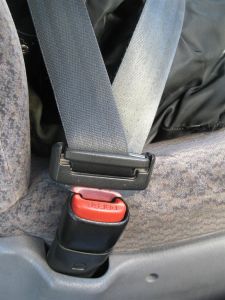
That’s exactly the kind of risk you’re taking when you get into a vehicle without buckling your seat belt.

If you want to protect yourself from the serious injury or death that could result from a car crash in Boston or elsewhere in Massachusetts, make sure you wear your seat belt – every time, no exceptions.

602535_seatbelt.jpg

Our Boston car accident attorneys understand the accident may not be your fault. And you are entitled to bring a claim regardless of whether you are wearing a seat belt. But belting up is your first line of defense.

We’re touching on this issues because, No. 1, we see far too many lives lost senselessly on our roadways, and No. 2, because the National Highway Traffic Safety Administration offers additional information about seat belt safety in the U.S.

The first is that buckling up is the best way to protect yourself in a crash. Seat belts have saved more than 75,000 lives from 2004 to 2008. To put that in perspective, picture a jam-packed, large sports arena. Wearing a seat belt keeps you inside your vehicle in the event of a crash. If you are ejected from the car, your chances of dying skyrocket.

Secondly, air bags alone aren’t enough to save you because they’re designed to work with the seat belts, not be used in place of them. If you don’t buckle up, the force of being thrown toward the airbag when it’s deploying could kill you.

Thirdly, when you do buckle up, make sure it fits you correctly. Every person is different, but the shoulder belt should come across the middle of your chest and away form your neck. The lap belt should go across your hips, just below your stomach.

Never put the shoulder belt behind your back or under your arm, as this could lead to serious injury in the event of a crash.
Continue reading

By all accounts, the scene was horrendous – a telephone pole snapped in half by the Ford Explorer that became wrapped around it after a drunk driving accident in Quincy.

Four people were seriously injured in the single-vehicle Boston car accident.
According to the Melanie’s Law , which increases the penalties for drunk driving in Massachusetts.

Some of the greatest changes under the new law include a requirement for an ignition interlock device for someone who wants to get their license back after their second conviction, even if the prior offense was decades ago. Additionally, your license can be suspended for consecutive terms (rather than concurrent, which means they run together) for DUI convictions or if you refuse a breath test when you’re pulled over. There are also harsher license suspensions for under-21 drivers.

Still, some would like to see even greater penalties. Mothers Against Drunk Driving is hoping that future Massachusetts lawmakers will include provisions that Melanie’s Law did not address, including a requirement for alcohol treatment programs for people who chronically drive drunk (especially for those behind bars). They would also like to see more police officers on the streets for deterrence purposes.

If you see a drunk driver on the road, call the police and report it.

Here are some tips from MADD on how to spot a drunk driver:

1. The person quickly accelerates or decelerates.
2. The driver is tailgating, zig-zagging or weaving across the roadway.
3. The driver may almost strike a curb, object or another vehicle 4. A drunk driver may stop without reason or brake erratically 5. A driver who is drunk will drift in and out of lanes.
6. An impaired driver will use improper signals, such as turning a blinker on when they aren’t turning.
7. A drunk driver is likely to swerve.
8. The person has a slower response to traffic signals, either making a delayed start or sudden stop.
9. The driver may forget to use their headlights, even if it’s dark.
10. A drunk driver may be traveling on the wrong side of the road, into oncoming traffic.
Continue reading

It’s been over a year since Gov. Patrick signed the state’s Safe Driving Law, which effectively bans Massachusetts motorists from sending, typing or reading electronic messages from a handheld device while driving.

It’s one of the most sweeping pieces of legislation in the country, and its designed to address the issue of distracted driving and quash the number of car accidents in Boston and throughout the state.

rainyday.jpgWhile officials in other states have debated text messages bans, the question that inevitably gets raised is: How will you enforce it? How will a police officer know whether the driver is sending a text or sending an e-mail?
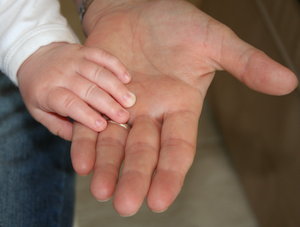

Our children are our most precious resource.

Yet, the leading cause of death for children ages 3 to 14 is nearly 100 percent preventable.

We’re talking about crashes.

childhands.jpg

And since 1975, more than 8,500 young lives have been saved by proper use of child safety seats and seat belts, according to the National Highway Traffic Safety Administration.

In Massachusetts, in an effort to drive down the number of fatal car accidents in Boston and beyond, the Boston Public Health Commission’s BuckleUp Boston campaign can help you find a technician who will assist you (and also may have information about how you can obtain discounted car seats).

Most children will ride in a rear-facing seat until they are at least 1-year-old and weigh at least 20 pounds.

Once they outgrow a rear-facing car seat, a booster seat is recommended because most children still won’t be big enough for an adult seat belt to fit them properly. Not having a proper fit could mean serious injuries to your child in the event of a crash.

If your child is involved in a crash, you may need to replace his or her car seat. The NHTSA recommends that you definitely need a new one if the crash was serious. If it was minor, you might not need one. A minor crash would be classified as when in which you could drive your vehicle away from the crash, the door nearest to the car seat wasn’t damaged, there were no injuries to anyone in your car, the air bags didn’t deploy and there is no visible damage to the car seat.

But even if you aren’t in a crash, it may still be time to replace your child’s car seat. One reason would be if your child is over the age of 6, and another would be if there is a recall on the car seat.

You can check recalls by going to NHTSA’s Child Safety Seat Recall List.
Continue reading

Roadways throughout the state of Massachusetts may be looking a little better in the near future. According to Richard Davey, CEO and Secretary of the Massachusetts Department of Transportation (MassDOT), funding from Obama’s Federal Highway Administration (FHWA) is being distributed throughout western and central Massachusetts. The federal aid was provided to the state to help repair roadways from the damage caused by the June 1st tornadoes and August 26th Tropical Storm Irene.
mEiaHHA.jpg
The first grant is about $4 million and will help local communities throughout the area to fix roadway damage from the tornadoes. The second grant is about $41 million and will help cover damages along the East Coast resulting from Tropical Storm Irene. The Hawlet, Goshen, Charlemont, Ashfield and Adams communities will be receiving these funds to help reduce the risks of car accidents throughout Massachusetts.

Our Massachusetts car accident attorneys understand that faulty and neglected roadways are a top contributor to a lot of traffic accidents in the area. With the storms we saw in 2011, there are roadways throughout the state that have been damaged and can be dangerous for motorists. These funds from the FHWA will be used to help increase traffic safety along these roadways. Government and Transportation officials have a responsibility to keep roadways throughout the area safe for travel. This can often be difficult with the recent budget problems. This funding will help motorists throughout the state who regularly traverse the roadways damaged by these catastrophic storms.

“The summer’s tornadoes and Hurricane Irene packed a double wallop, and it still shows in the damage to our roads, bridges, and infrastructure. You don’t bounce back from that kind of severe weather on the cheap,” said U.S. Senator John Kerry.

United States Senator Scott Brown says he is thankful local communities will be receiving the federal funds to help make the proper repairs to damaged roadways. He adds that the federal assistance will help to relieve some of the budgetary burdens that many areas around the country are fighting.

Communities that will be using the federal funds:

-Hawley will be using more than $7,000 to help repair the roadways along Route 8A.

-Goshen will be using more than $10,000 to help fix shoulder and road repairs along West Road.

-Clarlemont will be using more than $440,000 to fix roads and slopes along South River Road.

-Ashfield will be using about $15,000 to fix roads and slopes along Williamsburg Road.

-Adams will be using about $15,000 to fix slopes and roads along East Hoosac.

Within these areas, there was significant damage done to a number of bridges and roadways from the storms. In most areas, cleanup and repair efforts are still underway. Government officials have a responsibly to keep roadways safe for traffic.
Continue reading

As we recently reported on our Boston Personal Injury Attorney Blog, icy road conditions are causing a plethora of car accidents in Massachusetts. Slick, snowy and icy roadways are among the top causes of a number of traffic accidents thus far is 2012. These types of accidents are in fact preventable with the proper safe winter driving habits.
n0VWZRG.jpg
According to ABC5, a bridge expansion joint problem on Interstate 290 in Worcester was the scene of recent car accidents and a number of flattened tires. According to Massachusetts State Police, the area’s cold temps caused the expansion joint on the Interstate, near exit 20, to dislodge and to protrude from the ground. Shortly after, a tractor-trailer crashed into another vehicle in addition to a number of flattened tires.

Our Boston car accident attorneys understand that the latest reports concluded that nearly 10 vehicles received flat tires after driving over the expansion joint. Reportedly, officials with the Massachusetts Department of Transportation (MassDOT) have been out at the scene and have made the appropriate repairs to that portion of the roadway. All vehicles have been either fixed or removed from the Interstate and traffic is flowing steady. But this brings up an important issue that we’ve been talking about recently: the importance of safe winter driving. Our roadways are dangerous through the winter season and short and simple road trips can turn deadly without the proper driving techniques.

MassDOT is here to offer drivers throughout the state some safe winter driving tips:

-Make sure that you clean the snow and the ice from your vehicle’s lights and windows before driving. You should also clear it off of the roof and the hood for maximum safety.

-You never want to tailgate. You should always leave enough room between you and the vehicle in front of you to stop safely.

-Be cautious of the current driving conditions. Remember that the posted speed limits are for driving on dry pavement. Slow down when snow or ice plague the roadway.

-Curb all distractions to maximize your attention and ability to react to a road hazard.

-Know the current road conditions. You can call 511 from your cell phone to retrieve this information. If calling from a land-line phone, call (617) 986-5511 for Metro Boston info, (508) 499-5511 for Central Massachusetts info and (413) 754-5511 for Western Massachusetts info.

-Be easy on your brakes. You should brake early and brake correctly because it takes more time and distance to stop safely on slick roads.

-Remember that bridge decks freeze first. These roadways have a different exposure to the air and are more vulnerable to ice than ground-level roads. Conditions on bridges are much more dangerous in freezing temps.

-Be cautious on exit ramps. These areas oftentimes receive less anti-icing materials than other road area and can oftentimes be extremely slippery.

-Avoid using the cruise control.

-Look farther ahead into traffic than you normally do to help you to see upcoming roadway dangers before it’s too late.

-Allow maintenance vehicles and snow plows with plenty of room. It’s recommended that you stay at least 200 feet behind them and don’t ever pass on the right.

-Wear your seat belt to help reduce the risks of injury or death in the event of an accident.
Continue reading

Our Boston personal injury lawyers recently discussed the dangers of bicycle accidents at one main intersection in the city. While that intersection is definitely dangerous for bicyclists, it’s also extremely dangerous for pedestrians. We’re talking about the intersection of Vassar Street and Massachusetts Avenue. According to the Boston Globe, thousands of motorists, bicyclists and pedestrians cross through this intersection every day. Since 2007, there have been approximately 55 accidents reported at that intersection. One of them fatal and nearly 25 of them resulting in injury.
229337_175116409209205_100001325410820_392097_119830_n.jpg
“For the amount of volume that goes through that intersection…I would say it is one of our highest accident locations in the city,” said Police Deputy Superintendent Jack Albert.

Our Massachusetts bicycle accident lawyers are concluding our 6-part blog series with a discussion of the risks, dangers and consequences of pedestrian accidents in the state. This is the 6th entry of our blog series discussing New Year’s Resolutions that residents can take in 2012 to make our roadways safer for everyone.

Road design enhancements were made to Massachusetts Avenue last year. But many believe that not enough has been done. Officials with MIT urged transportation officials to adjust the timing of the traffic lights to make the intersection more pedestrian friendly. Still, the Vassar Street and Massachusetts Avenue intersection remains one of the city’s top hot spots for these types of accidents. In 2011, there were nearly 20 accidents reported there, making it second in the top five most dangerous intersections in Massachusetts. The number one most dangerous intersections was at Gardner Street and Massachusetts Avenue in Harvard Square.

According to city records, of the 55 accidents that occurred at this intersection since 2007, three of them involved pedestrians. A majority of these accidents involved motorists making right-hand turns and colliding with bicyclists and pedestrians because they just failed to see them.

Nationwide statistics reveal that there are nearly 110 million Americans who walk regularly as a mode of transportation. The New England area accounts for more than 10 percent of these pedestrians.

According to the Commonwealth of Massachusetts, the City of Boston is ranked one of the most dangerous areas for pedestrian accidents out of the country’s 52 largest metropolitan areas. In Boston, an average of 485 pedestrians were killed on our city’s roadways from 2000 to 2009, according to Transportation for America.

Our Boston pedestrian accident lawyers are asking residents to be cautious when walking through the city. We understand the convenience that comes with walking in the area, but we ask that everyone be cautious when doing so. Be cautious and alert for passing motorists. Our sidewalks may be flooded with pedestrians, but our roadways are flooded with dangerous drivers. Let’s all work together to travel safely among one another to enjoy a safe 2012.
Continue reading

“This intersection makes me nervous,” Marcia Pearson, a Somerville bicyclist, told a newspaper recently.

What Pearson is talking about the intersection of Vassar Street and Massachusetts Avenue. According to local police officers, it’s an extremely dangerous intersection. Every day, there are thousands of motorists, pedestrians and bicyclists who use the intersection near the Massachusetts Institute of Technology campus. Intersection car accidents in Massachusetts are common at this intersection because of the high volume of traffic that this intersection withstands all day long.

Our Boston car accident lawyers understand that Cambridge officers responded to nearly 60 accidents at this intersection in 2007. Of those, 24 involved vehicles and bikes. Many resulted in injury, and some in death, according to The Boston Globe. For this reason, officers are targeting this intersection as a part of a roadway safety campaign that is being used by officials to improve traffic safety across the city, cracking down on those who violate traffic laws.
2dRQwpv.jpg
According to Jack Albert, Police Deputy Superintendent, accidents are inevitable with so many people using this intersection daily, even though there have already been efforts made to make the intersection safer.

Last year, road enhancements were made on Mass Ave, but officials with MIT urge the state’s transportation department to change the timing to the traffic lights at the intersections to make the intersection safer.

But even with the improvements, there were 16 accidents at the intersection last year. According to the Police Department’s list of the top five most dangerous intersections of 2011 in the city, this intersection ranked second, right behind Massachusetts Avenue and Gardner Street in Harvard Square.

This is the fourth entry of a 6-part blog discussing simple New Year’s resolutions residents can make to increase the safety of all travelers on our roadways. This blog entry will be discussing simple adjustments that travelers can make at intersections to help reduce the number of accidents that we see every year in these areas.

Safe Driving Tips from the Commonwealth of Massachusetts:

-Always obey the speed limit. Remember that posted speed limits are the limits for ideal weather conditions. Slow down in poor weather conditions, like snow, fog and rain.

-Follow the two-second rule. Never tailgate. Allow vehicles around with you ample space. The more space between you and other vehicles the longer reaction time you allow yourself.

-Always use your turn signal to alert drivers, pedestrians and bicyclists about your intended maneuvers.

-Respect the crosswalk. You want to stop behind the line when stopping for a traffic light. Don’t block these walkways.

-Never blog an intersection. Make sure you can make it safely through the entire intersection safely before proceeding through.

-Put down the distractions. Passing through an intersection requires your full attention.
Continue reading

Contact Information